![map[author:Jeremy Bergevin email:walking.running276@8alias.com]](/jeremy.jpeg)
Wordle With a Twist?
The inciting incident.
I recently came across this post on HN which was a funny knock-off of Wordle with only binary. If you think about it for about a second, you realize it’s not much of a game (and the creator seems to have understood this 😉).
However, someone in the comments mentioned (while seemingly not understanding the joke?) that it would be more difficult with hex. This idea popped something in my brain and I thought, “huh, it might be fun to do a hex color guessing game”.
Getting the prototype up and running, fast.
I decided to use HTML/CSS/JS in addition to JetBrains Junie to get a prototype going very quickly. Why use an AI agent? I knew with certainty that I could code a prototype like this by hand (read: manually). The most important thing was speed to a functioning prototype (STFP). Last among the list of priorities was the quality or arrangement of the code, the framework, etc.
The main impetus of even trying this process was twofold:
- What does the seed of this idea feel like?
- Is the basic idea even fun OR can it be iterated to be fun?
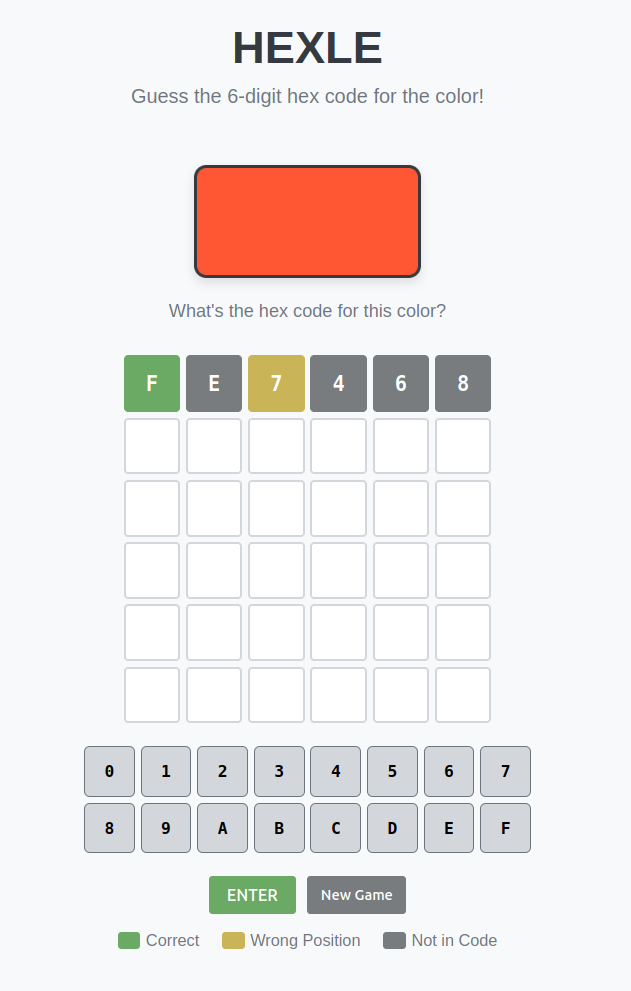
I provided a relatively detailed prompt indicating my aim for the game. Fortunately for me, the AI agent is well aware of the existence and functioning of Wordle1, so my prompt didn’t require excruciating detail in order to achieve the most basic functionality. After about 5 minutes, here’s what we’ve got:
So, is it fun?
Any of you that thought through it for roughly 15 seconds probably realized that, no, this basic idea isn’t very fun2. Pivotally though, there are some minor adjustments that can be made to make certain aspects of the design more engaging and fun.
For instance, I added a small box next to the current color to indicate the color of the most recently guessed hex value. I also added an arrow indicator to give players an idea of which direction each incorrect hex value needs to go to get closer to the correct values.
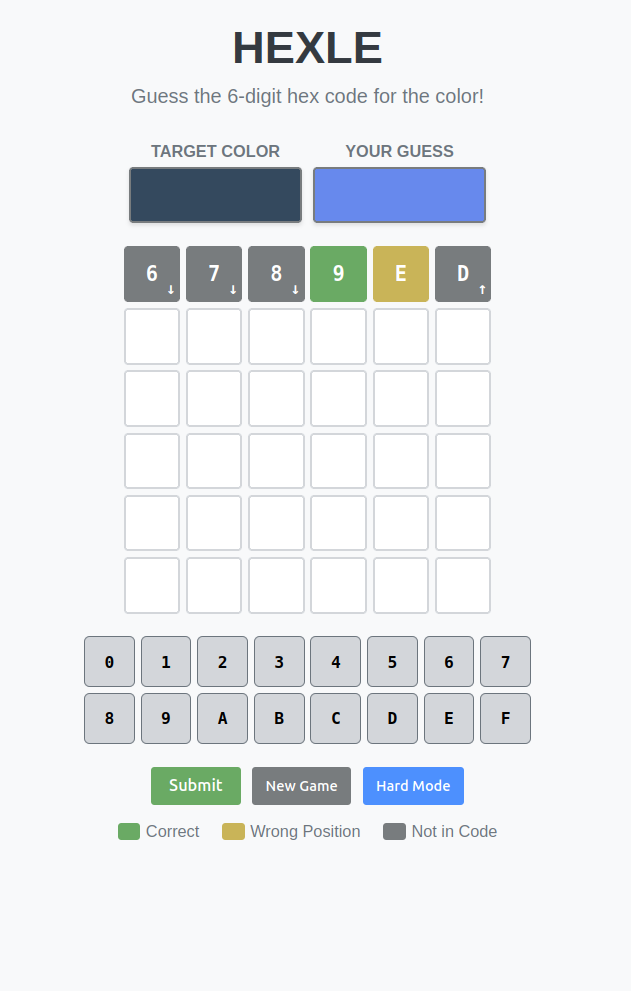
These adjustments don’t make the game irresistibly fun by any means. But, it definitely gives it something more engaging.
What’s interesting is that once the first guess is placed, the game becomes more about thinking through the arrow indicators, and how the player might adjust the previously guessed color to get even closer to the target. It feels akin to setting up a round of gameplay by first making a dice roll in a board game.
Best way to cement my genius in the annals of history? A unique name.
Wordle with a Hex color twist?
Hexle
Ok, that’s the most obvious name possible, but whatever. It’s faster than saying “hex-color-wordle-clone-guessing-game”, so it has that going for it.
Onward? Takeaway?
I actually think there’s a bit more juice left here to squeeze, so I’m going to keep iterating on this. I think the ultimate game (as far as it goes) will be a significant departure from its Wordle origins3.
The game literally doesn’t even have a loop yet. Once you’ve got the correct answer, nothing happens. I can start a new game by refreshing the browser page or clicking the New Game button. The whole thing is very rough and ready. Emphasis on “ready”.
I am actually pleasantly surprised by how useful it was to get such a simple prototype up and running in just a couple minutes. The key takeaway for me is the fact that the interesting part about this prototype was never going to be getting the initial prototype going (read: programming manually). It was always about minimizing the STFP.
I’m going to keep iterating on this and see where it takes the game. I’m interested to see if I can “find the fun” in this game. We’ll see.
Notes
-
In so far as any LLM can actually “understand”, be “aware”, etc. You get what I mean. ↩︎
-
Unless you’re the type of person that finds the “Guess What Number I’m Thinking Of” game fun, in which case you may have a blast! ↩︎
-
Probably a wise legal choice given NYT’s very cool behavior related to Wordle elsewhere. ↩︎